
It’s late.
Your brain has decided now is the perfect time for a full audit of your life. It’s running a highlight reel of:
- Everything you’ve ever said or done slightly wrong
- Everything that could go wrong tomorrow
- And a few things that have never even happened (but might, just in case)
And somewhere in the middle of it all, you’re Googling:
“why do I overthink everything?”
I see you. And I’m here to help.
Today, we’re gonna take a look at what’s actually going on (from a brain science perspective) and what we can do to help.
Because, believe it or not, your brain isn’t trying to be an a**hole. It’s trying to protect you.
Why your brain overthinks
If you’re here, you’re most likely intelligent, capable and self-aware. Which makes it extra frustrating. Why does your mind insist on running a full risk assessment on whether you used the correct emoji?
From a brain perspective, overthinking has nothing to do with how smart you are. It’s usually about threat detection and uncertainty.
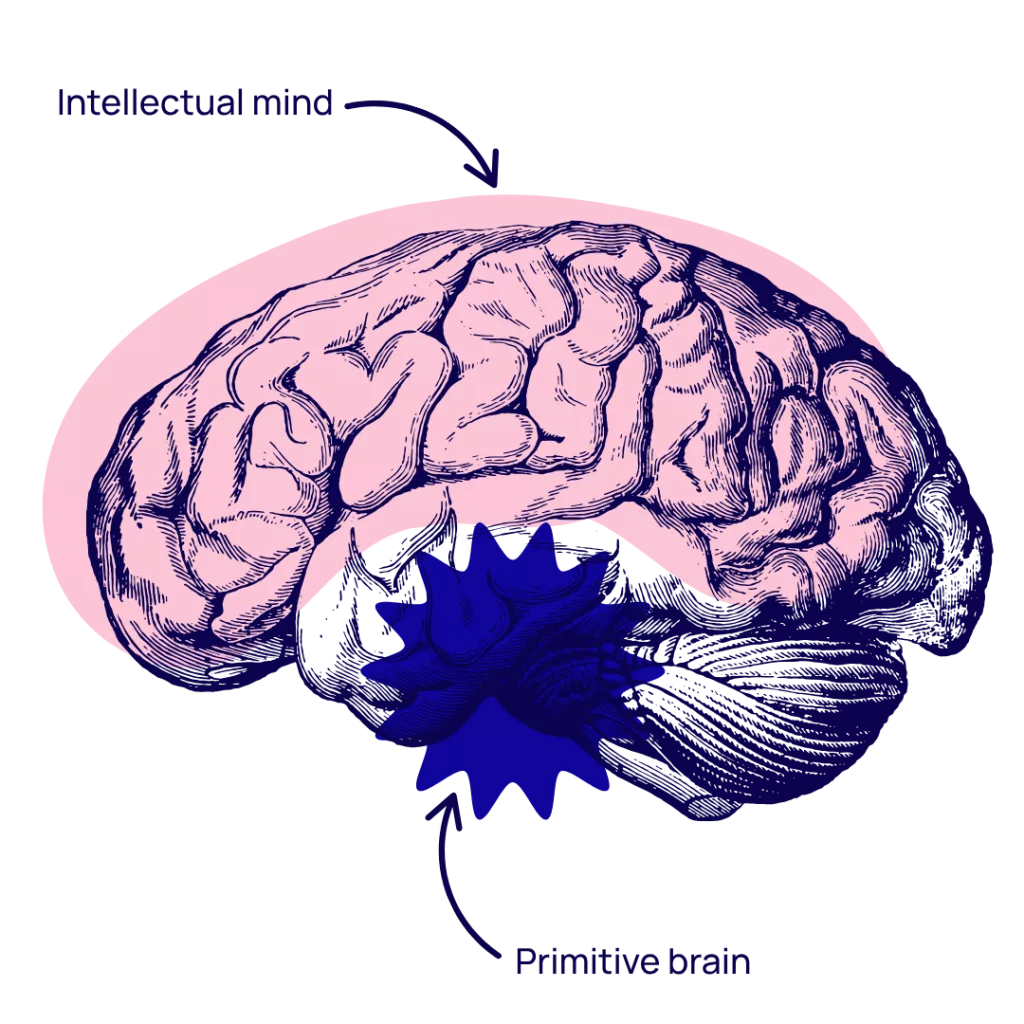
Two key systems are involved:
- The primitive brain: your alarm system. It scans for danger (including social danger).
- The intellectual mind: the thinking, planning, creative part of you.
When your primitive brain senses a possible threat (embarrassment, rejection, failure, loss of control) it sends a signal: “Hey, we’ve got a problem here! Solve this.”
Your brain responds the only way it knows how: by thinking harder.
- More scenarios.
- More analysis.
- More contingency plans.
Unfortunately, thinking doesn’t switch off the alarm. So the brain tries… even more thinking. But certainty never quite arrives. So the loop continues.
This can be especially common in conditions like:
But it’s not always a one-way street.
The problem that disguises itself as the solution
It’s easy to assume that anxiety causes overthinking. And sometimes it does. But it can also work the other way around.
Overthinking itself can start to create anxiety.
Dr Jessamy Hibberd, author of The Overthinking Cure, puts it perfectly:
Overthinking is the problem that disguises itself as the solution.
When we overthink, it feels productive. It feels like problem-solving. But instead of resolving the issue, it can keep the mind circling the same thoughts again and again, amplifying distress rather than relieving it.
You may already know this:
If you start thinking about something embarrassing or hurtful from the past, it won’t stay “just a thought” for long. After a while your heart might start racing. Your chest tightens. Your mood darkens.
Nothing new has actually happened. Yet your body responds as if the event is unfolding again in real time.
This is a powerful demonstration of how the brain doesn’t always distinguish between imagination and reality, so the emotional and physical response can be very real.
The encouraging part is that this also works both ways.
Just as your thoughts can amplify stress and anxiety, they can also be used to create feelings of safety, confidence and calm. The key is learning to direct your attention intentionally rather than letting your mind default to scanning for problems.
A small exercise to retrain your brain
Take a notebook and write down: “Times I trusted myself.”
Set a 10-minute timer and write as many examples as you can. They don’t have to be big and dramatic. Small moments count: a situation you handled well, a time things worked out, that decision that led to a small win.
Then, starting tomorrow morning, choose one example from your list.
Spend a minute or two savouring that moment. Notice what it feels like in your body – perhaps a sense of relief, steadiness, warmth or confidence. Let yourself sit with that feeling rather than rushing past it. You may even wish to carry it with you throughout the day.
This might sound simple, but it’s doing something important. You’re teaching your nervous system a new pattern. Over time, your brain becomes a little less practiced at scanning for danger and a little more practiced at recognising safety and self-trust.
Sleep: the secret ingredient to curb overthinking
You’ve probably noticed that overthinking is always way worse when you’ve had a bad night’s sleep. This is no coincidence.
Sleep is not just “nice to have”. It’s when your brain resets. During deep sleep, your nervous system settles, stress hormones reduce, and your brain processes emotional experiences from the day.
Without sleep, the primitive brain (your threat detector) becomes more reactive, and the intellectual mind (your rational, perspective-giving brain) has less influence.
This can lead to a bit of a vicious cycle:
- Less sleep = waking up with unprocessed stress
- More stress = more overthinking
- More overthinking = less sleep
Breaking that cycle (even gently) can make everything else feel more manageable.

I’ve created a free sleep hypnosis audio designed to:
- Quiet the brain before bed
- Calm the nervous system
- Reduce mental chatter
- Help you fall asleep more easily
So many of my clients use it, and it really does make a difference!
(If you have a chance to try it, I’d love to know.)
When to get extra support
If overthinking is:
- Affecting your sleep
- Fuelling anxiety or panic
- Linked to OCD patterns
- Connected to phobias
- Getting in the way of your daily life
You don’t have to untangle it alone. Sometimes you just need someone who understands how your brain works and can help it settle.
Let’s talk
Overthinking is a protective pattern. But it’s a pattern that can be retrained. Through approaches like Solution Focused Hypnotherapy, we work with:
- The subconscious threat response
- Nervous system regulation
- Reducing compulsive mental loops
- Increasing tolerance for uncertainty
Our goal is to get that intellectual mind back in the driver’s seat. Because when the nervous system feels safer, the thinking brain quietens naturally.
If you’d like more personalised support (whether this is anxiety, ADHD, OCD patterns, phobias, or just a brain that won’t switch off) you’re very welcome to book a free consultation.
No pressure. No hard sell. Just a calm conversation about what’s going on and whether hypnotherapy might help.
And if you’re reading this while overthinking whether you really count as someone who overthinks… That’s probably your answer.